Heritable Health
HeritableHealth
Heritable Health
가입하기

Reading Your Marker Cards

Heritable Health surfaces genetic-risk variants drawn from peer-reviewed research, GeneReviews, and ClinVar. This guide explains how to read each card - the metrics, the evidence tiers, and how to talk about your results with a clinician.

The three numbers that describe a variant

Geneticists use different units depending on whether a variant causes a single disease (Mendelian) or contributes a small effect to a complex disease alongside many others. Our cards show whichever number is appropriate for that variant.

Penetrance

Used for Mendelian variants

Of people with this genotype, what percent develop the disease over a lifetime?

Range: 0% – 100%

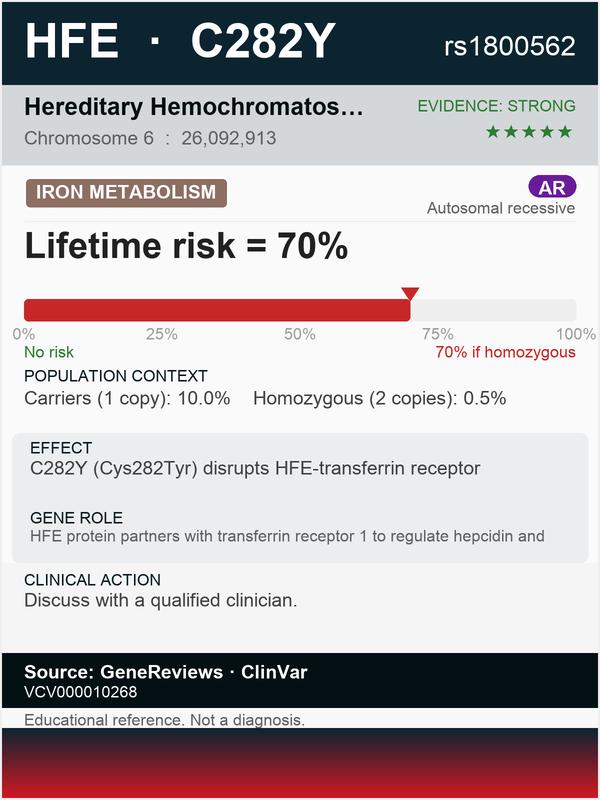
Example: HFE C282Y homozygotes have ~70% lifetime risk of iron overload.

Odds Ratio (OR)

Used for complex / polygenic variants

How much more (or less) likely is the disease in carriers compared to non-carriers?

Range: 0 – ∞ (1.0 = no effect)

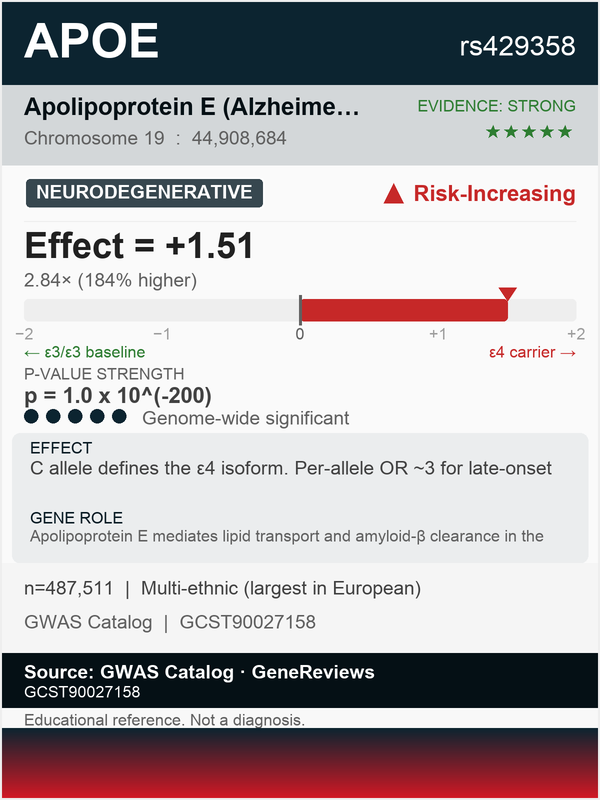
Example: APOE-ε4 has OR ≈ 3 (heterozygous) for late-onset Alzheimer's. Carriers are 3× more likely to have AD than non-carriers.

log₂(OR)

Same as OR, on a symmetric scale

The log of the odds ratio. We display this as the primary effect-size on cards because it's symmetric — equal-strength variants get equal-magnitude numbers.

Range: −∞ to +∞ (0 = no effect)

Example: log₂(2) = +1; log₂(0.5) = −1. Both represent the same magnitude in opposite directions.

Mendelian vs complex variants

Mendelian (single-gene)Complex (polygenic)
Caused byONE gene with a high-impact mutationMANY genes (often hundreds) plus environment
InheritancePredictable: dominant, recessive, X-linked, mitochondrialNo simple pattern; risk = sum of small effects
Number of variants1–few rare, high-impactHundreds, each tiny effect
Card archetypemendelian — penetrance barcomplex_trait — log₂(OR) bar
ExamplesHFE, F5 Leiden, LRRK2, BRCA1/2, CFTRAPOE/Alzheimer's, TCF7L2/T2D, FTO/obesity

Card archetypes

Complex-trait cards

Use a log₂(OR) bar centred at 0. Negative values left of center, positive values right. Equal-strength variants are equidistant from center.

Mendelian cards

Use a 0–100% penetrance bar. Shows lifetime disease risk if you have the genotype. Includes inheritance pattern (AD/AR/XLR) and population frequencies.

Carrier cards

Show carrier frequency by ancestry plus a couple-risk panel (1 in 4 affected children if both partners carry). Used on Paired Genes, Well Matched, and Gene Pool.

Evidence tiers

Every card carries an evidence tier badge in the top right. We assign tiers based on independent replications across multiple studies and inclusion in authoritative resources like GeneReviews and ClinVar.

TierStarsMeaning
STRONG★★★★★Genome-wide significant in mega-meta-analyses or GeneReviews-listed Mendelian variant.
VALIDATED★★★★Three or more independent GWAS replications.
MODERATE★★★1–2 replications with some heterogeneity across studies.
EMERGING★★Single large study, awaiting independent replication.
EXPLORATORYCandidate-gene-era finding with weak modern replication. Treat with caution.

Inheritance patterns

CodePatternWhat it means
ADAutosomal dominantOne affected copy is enough to cause disease. Each child of an affected parent has a 50% chance of inheriting it.
ARAutosomal recessiveTwo affected copies needed. Carriers (heterozygous) are usually asymptomatic. If both parents are carriers, 25% of children are affected.
XLRX-linked recessiveMostly affects males (one X chromosome). Female carriers usually asymptomatic; 50% of male children of carrier mothers are affected.
XLDX-linked dominantAffects both sexes; daughters of affected fathers always inherit.
MTMitochondrialInherited only from the mother (mitochondrial DNA). All children of an affected mother inherit; none of an affected father's.

How to read the bar visualisation

On complex-trait cards, the bar is centred at 0 (the no-effect point). The triangular marker sits at log₂(OR), so:

  • A marker far to the left = strongly negative effect (lower than baseline).
  • A marker near center = small effect, close to no effect.
  • A marker far to the right = strongly positive effect (higher than baseline).

Color follows the site's clinical convention. On health-focused sites, increased disease risk is shown in red. The card always lists the original odds ratio and a plain-language multiplier (e.g. “0.57× = 43% lower”) in addition to the log₂ value.

Sample cards

Examples of the cards you'll see when your results are ready. Each card is generated for a specific variant; what you see depends on your DNA, your ancestry, and which conditions are on this site's panel.

Sample marker card for APOE - late-onset Alzheimer's (rs429358)
APOE - late-onset Alzheimer's (rs429358)
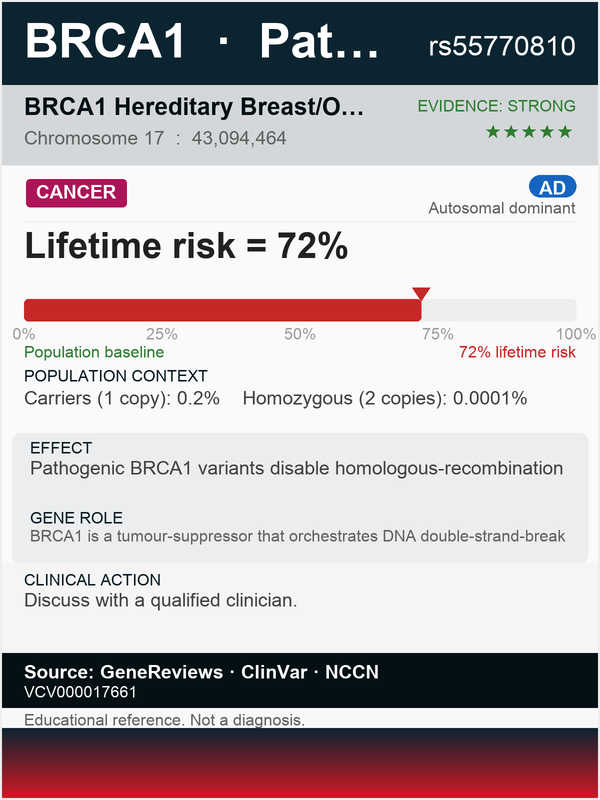
Sample marker card for BRCA1 - hereditary breast/ovarian cancer (rs55770810)
BRCA1 - hereditary breast/ovarian cancer (rs55770810)
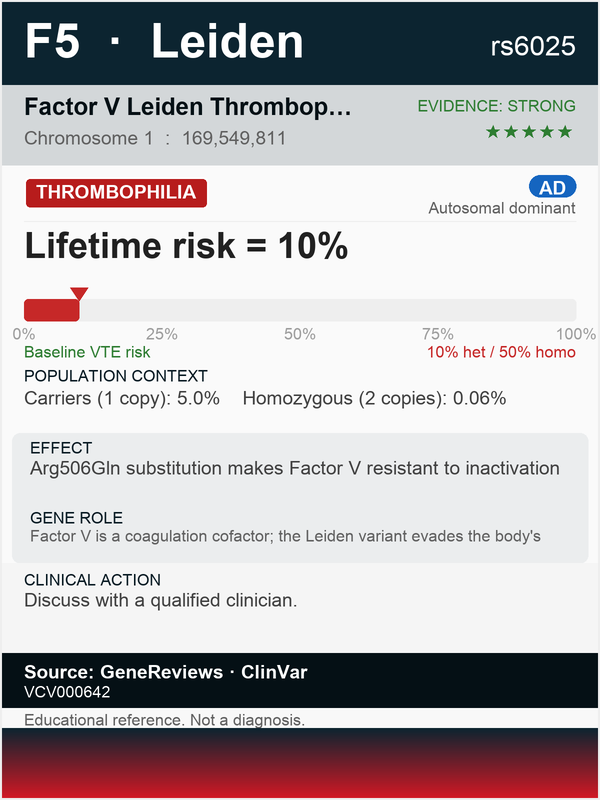
Sample marker card for F5 - factor V Leiden thrombophilia (rs6025)
F5 - factor V Leiden thrombophilia (rs6025)
Sample marker card for HFE - hereditary haemochromatosis (rs1800562)
HFE - hereditary haemochromatosis (rs1800562)
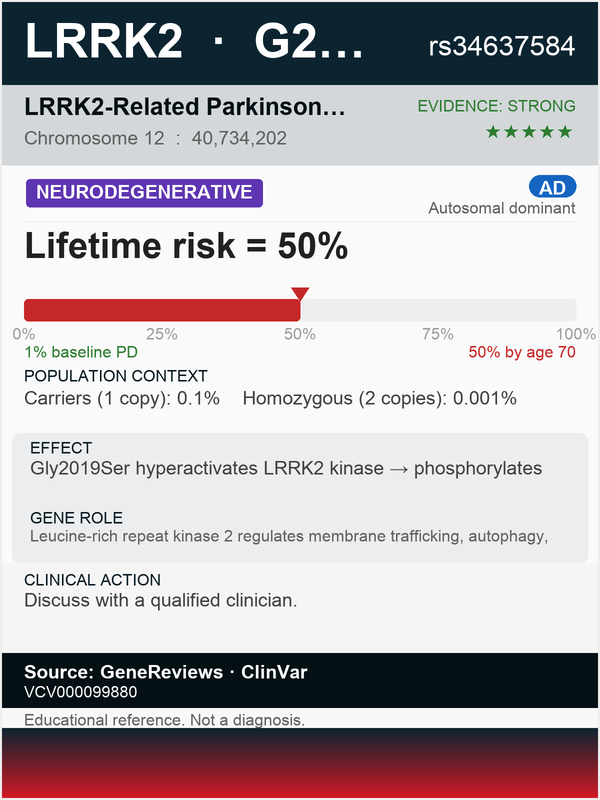
Sample marker card for LRRK2 - Parkinson's disease (rs34637584)
LRRK2 - Parkinson's disease (rs34637584)
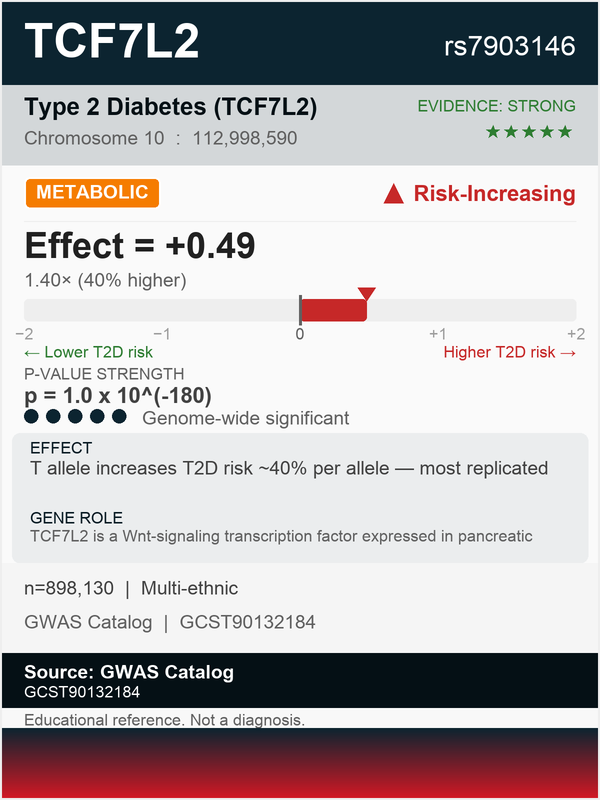
Sample marker card for TCF7L2 - type 2 diabetes (rs7903146)
TCF7L2 - type 2 diabetes (rs7903146)

These cards are educational, not clinical.

Genetic risk varies enormously based on environment, lifestyle, and other genes. Always discuss results with a genetic counselor, physician, or qualified clinician before making medical decisions. The evidence-tier badge tells you how confident the science is — “EXPLORATORY” findings should not drive clinical action.